Population-level outcomes of imlunestrant in patients with metastatic breast cancer using a simulated dataset
Charles Jia, MSc
Abstract
Introduction
70% of all breast cancer patients have ER+/HER2- metastatic breast cancer. Imlunestrant has been proposed, through the EMBER studies, as a replacement to standard concurrent endocrine therapy treatments to CDK4/6 inhibitors. Having been tested exclusively in clinical trials, real-world evidence studies are necessary to supplement clinical trial weaknesses and validate results in real-world diverse patient populations.
Methods
This retrospective cohort study used de-identified health and administrative data simulated using Claude.ai to identify adults with ER+/HER2- metastatic breast cancer who initiated either imlunestrant or standard endocrine therapy between September 2025 to May 2026. The primary endpoint as progression free survival. Secondary endpoints were various adverse events. Kaplan-Meier and multivariable Cox models were used to compare survival outcomes between groups.
Results
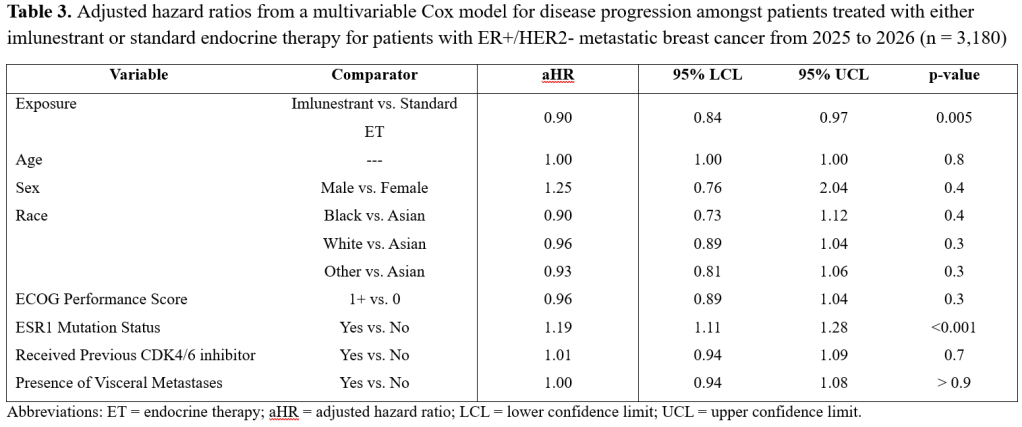
Propensity score matching yielded a final study cohort of 3,180 patients. Imlunestrant significantly prolonged median progression free survival (imlunestrant: 5.2 months, 95% confidence intervals 4.9 to 5.7; standard endocrine therapy: 4.8 months, 4.5 to 5.2; p = 0.02) and significantly decreased the risk of disease progression (adjusted hazard ratio 0.90, 95% confidence interval 0.84 to 0.97; p-value 0.005). The safety analysis found imlunestrant-recipients experienced significantly greater unadjusted incidences of low-grade fatigue, diarrhea, abdominal pain and decreased appetite.
Discussion
Our results suggest imlunestrant may be superior to existing standard endocrine therapy options in preventing disease progression amongst patients with ER+/HER2- metastatic breast cancer. Imlunestrant has similar safety outcomes to existing standard endocrine therapy options with the exception of the increased incidences of several lower-grade events.
1. Introduction
Approximately 70% of all breast cancer patient have estrogen receptor-positive (ER+) / human epidermal growth factor receptor 2-negative (HER2-) metastatic breast cancer(mBC)1. Current preferred first-line treatment involves the use of cyclin-dependent kinase 4 and 6 (CDK4/6) inhibitors combined with endocrine therapy2. Abemaciclib, as an example, is a potent CDK4/6 inhibitor that has shown profound benefits in patients across all therapeutic contexts with endocrine therapy3–5.
Fulvestrant is the only estrogen receptor (ER) degrader, meaning it directly antagonizes ERs as well as aromatase inhibitors to block estrogen production, that has been approved as a monotherapy and as part of combination therapy4. However, fulvestrant has its substantial disadvantages. These include poor oral bioavailability limiting dose and dose-dependent efficacy, the perceived pain and burden of injections, and its limitations in patients with ESR1 mutations6–10. New oral selective ER degraders, like imlunestrant, have been developed with efficacy and patient experience by means of ease of administration in mind.
Imlunestrant, a next-generation and brain-penetrating oral selective ER degrader and pure ER antagonist that continuously inhibits ERs, even in ERS1-mutated breast cancer11. Imlunestrant has been tested extensively in clinical trials. In the phase 1 EMBER study, imlunestrant demonstrated low-grade toxicity effects, favorable pharmacokinetics and antitumor activity in patients with ER+/HER2- breast cancer alone and in combination with abemaciclib12. The EMBER-3 study found imlunestrant alone significantly increased progression-free survival in patients with ESR1 mutations, but not the overall population, whereas imlunestrant-abemaciclib together significantly improved progression-free survival regardless of ESR1-mutation status13.
However, clinical trial evidence is not without its weaknesses. The generalizability of clinical trial results to real-world populations are limited by strict eligibility criteria, small sample sizes and shortened follow-ups14–18. These considerations increase the value of real-world evidence in complementing clinical trial evidence, validating clinical trial results and demonstrating how real-world populations respond.
This is a mock publication. This publication is meant to serve the following goals: simulate a dataset using artificial intelligence, specifically Claude.ai; apply data cleaning and statistical analysis techniques on this simulated dataset; and to practice manuscript writing.
2. Materials and Methods
2.1 Study design
An observational, retrospective population-based study of adults aged 18+ with ER+/HER2- breast cancer who initiated imlunestrant treatment between 25 September 2025 to 25 May 2026 was conducted. This study used the Reporting of studies Conducted using Observational Routinely-collected Data (RECORD) guidelines. This statement is presented in Table S1.
2.2 Data sources
In this simulation paper, Claude was used to simulate de-identified health and administrative data. The prompt for this can be found in Table S2. In real-world practice, linked administrative and health databases using unique coded identifiers would be used. This data could be gathered from organizations like ICES, an independent and non-profit research institute whose legal status under Ontario’s health information privacy law allows it to collect and analyze healthcare and demographic data, without consent, for health system evaluation and improvement.
The details of the databases used, definitions, data sources, variables and reporting details would usually be listed here in supplemental tables. The same can be said for codes used to define therapies or diagnoses. The simulated dataset will be available for use in an associated github repository located at the end of this mock paper.
2.3 Patient population
Women (of any menopausal status) or men 18 years of age and older who had locally confirmed ER+/HER2- breast cancer were eligible. Key exclusions include any duplicate records, any records with missing values, patients who were under the age of 18, and those whose date of disease progression occurred at or before the date of imlunestrant treatment initiation.
2.4 Exposure
The exposure of interest is the oral reception of imlunestrant (400 mg once daily) against any standard endocrine monotherapy, like exemestane or fulvestrant. If using real-world data, specific codes used to identify the exposure would be listed in supplemental material.
2.5 Study endpoints
The primary endpoint is investigator-assessed progression-free survival with imlunestrant as compared to standard therapy among patients with ESR1 mutations. In the real-world, this would be a complicated task outside of clinical trials. This would involve a team of investigators, working with real-world charts and readings from patients who are or are not receiving imlunestrant, determining when the disease had progressed. Progression-free survival is defined as the length of time from the date of imlunestrant treatment initiation to the date of death or reaching the maximum follow-up date.
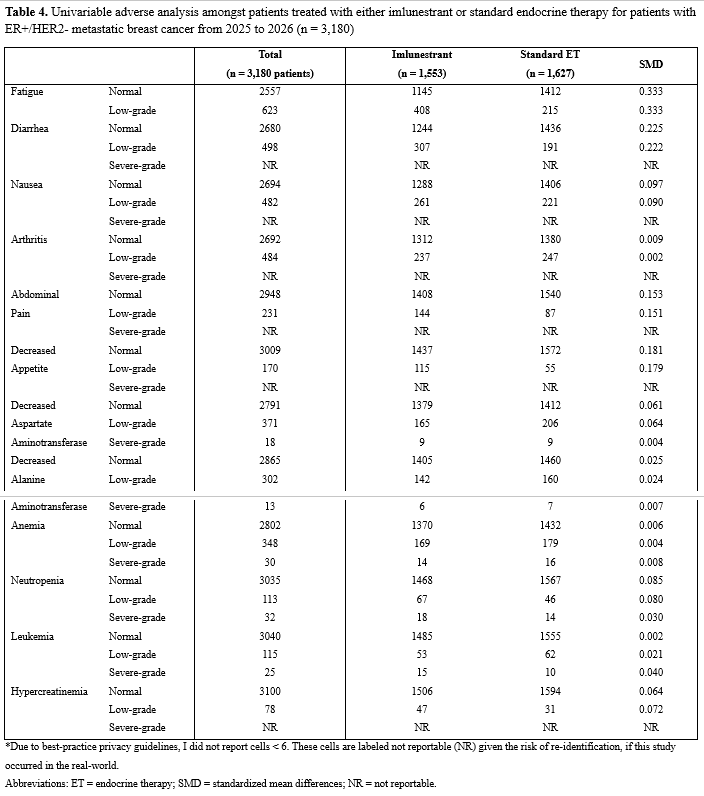
The secondary endpoint would be safety-related endpoints. These include patient-reported outcomes like fatigue, diarrhea, nausea, arthralgia, abdominal pain, vomiting, and decreased appetite; and laboratory measurements like aspartate aminotransferase increase, alanine aminotransferase increase, anemia, thrombocytopenia, neutropenia, leukopenia and hypercreatinemia. Laboratory measurements were graded using the National Cancer Institute Common Terminology Criteria for Adverse Events v5.0 and were graded as low-grade (grades 1-2) or severe-grade (grades 3-4).
2.6 Statistical analysis
Eligible participants were matched 1:1 using a propensity score conditioned upon age, sex and race. Baseline characteristics of the propensity-score matched cohort were presented descriptively, with comparisons between treatment groups assessed using standardized differences. Kaplan-Meier survival functions and log-rank tests were used to estimate the unadjusted probabilities for progression-free survival. A multivariable Cox model was used to estimate the adjusted hazard ratio for progression-free survival. Covariates included age, sex, ethnicity, ECOG performance, ESR1 mutation status, receipt of a previous CDK4/6 inhibitor, and presence of visceral metastases.
A standardized mean difference (SMD) of > 0.10 or a p-value < 0.05 were considered statistically significant19,20. Complete case analysis was used to address missing data in this study. All statistical analyses were performed using RStudio (Posit Software, PBC, Boston, MA).
3. Results
3.1 Patient population
A total of 5,000 patients, aged 18+ who received imlunestrant or another endocrine therapy from 25 September 2025 to 25 May 2026 diagnosed with ER+/HER2- mBC, were identified (Figure 1). Patients were excluded as a result of complete case analysis or duplicate records (n = 1,716 patients), or propensity score matching (n= 104 patients). This resulted in 3,180 eligible patients after propensity score matching. An analysis of the distributional and covariate balance of the propensity score matched cohort did not reveal any significant differences between them (Figure S1, Figure S2).
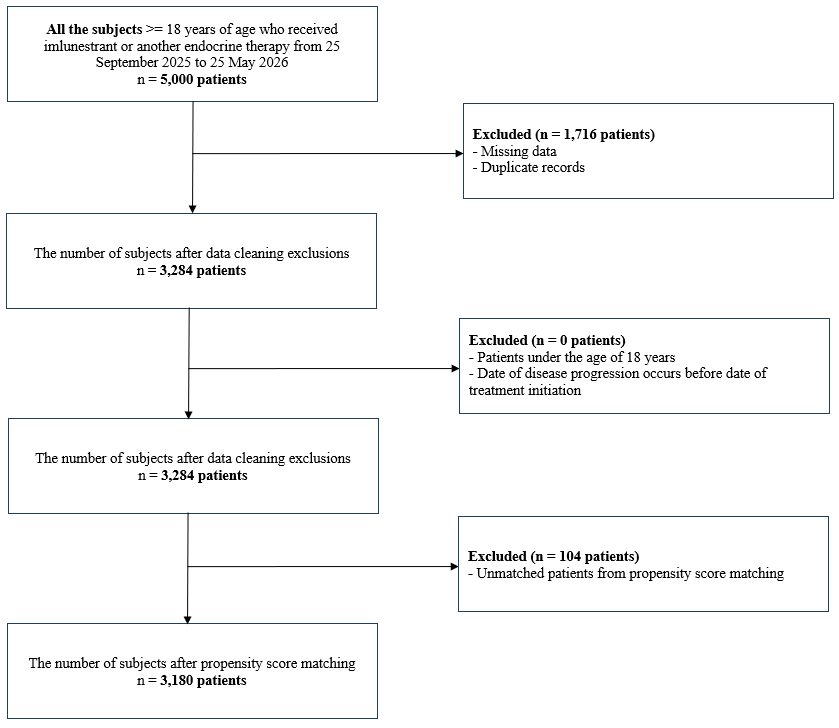
Figure 1. Inclusion and exclusion flowchart for patients treated with either imlunestrant or standard endocrine therapy for patients with ER+/HER2- metastatic breast cancer from 2025 to 2026
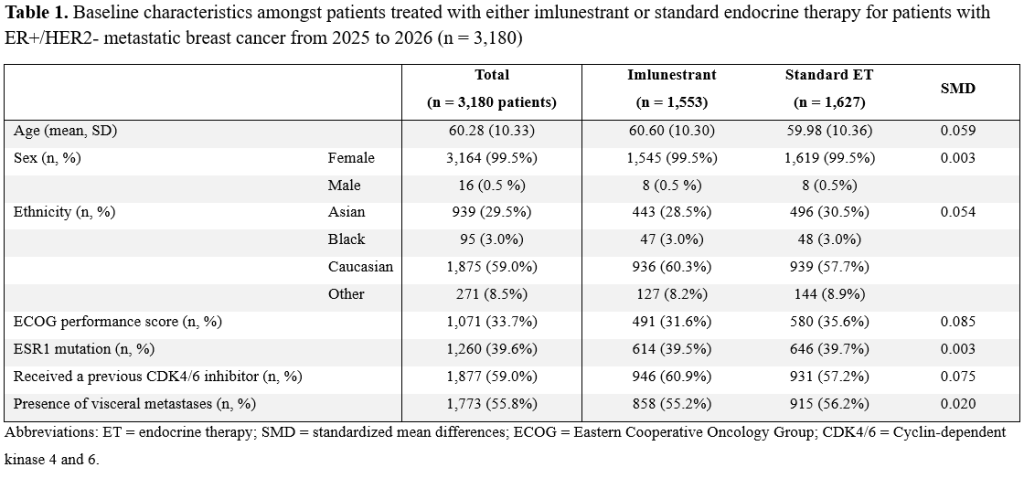
Consequently, there were no significant differences between the two exposure groups (Table 1). The average age of patients receiving imlunestrant was 60.60 years [standard deviation (SD) 10.30) compared to the 59.98 years (SD 10.36) in the standard ET group. Of the 3,180 patients, 99.5% were female. The ethnic makeup of the propensity score matched cohort was 59.0% Caucasian, 29.5% Asian, 3.0% Black, and 8.5% other ethnicities.
3.2 Progression free survival
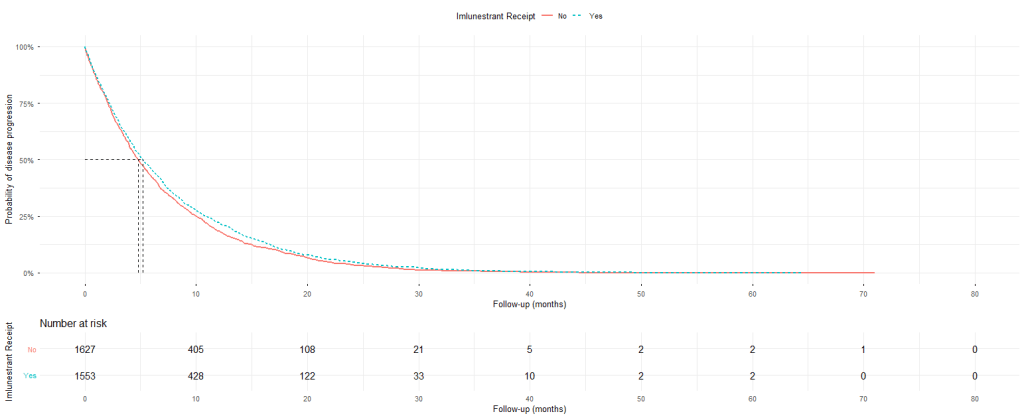
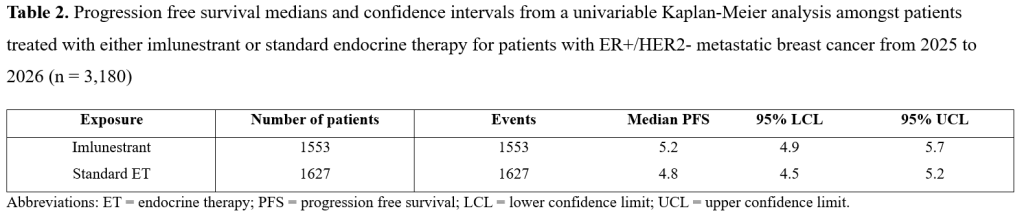
Amongst the 1,553 patients who received imlunestrant, the median progression free survival was 5.2 months [95% confidence intervals (CI) 4.9 to 5.7). This was significantly longer than the median progression free survival of the standard ET group (median 4.8 months, 95% CI 4.5 to 5.2). These results can be seen in Figure 2.
The multivariable Cox analysis (Table 3) revealed a significantly lower risk of disease progression amongst patients receiving imlunestrant compared to patients receiving standard ET [adjusted hazard ratio (aHR) 0.90; 95% CI 0.84 to 0.97; p-value 0.005).
3.3 Adverse events
The safety analysis included 3,180 patients. Several significant differences were found between the imlunestrant and standard ET groups. Imlunestrant-recipients experienced significantly greater unadjusted incidences of low-grade fatigue (SMD 0.333), low-grade diarrhea (SMD 0.222), low-grade abdominal pain (SMD 0.151), and low-grade decreased appetite (SMD 0.179). Any other safety signals were not significantly different between the two.
4. Discussion
In summary, imlunestrant significantly prolonged median progression free survival and significantly decreased the risk of disease progression compared to patients receiving ET. However, patients receiving imlunestrant can expect to experience significantly greater unadjusted incidences of low-grade fatigue, diarrhea, abdominal pain and decreased appetite.
4.1 Comparison to other studies
This simulation study was conducted to validate and verify the results of Jhaveri et al. (2025) in a real-world, population-based study using de-identified health and administrative databases. That study found a median progression free survival of 5.6 months with imlunestrant compared to 5.5 months with standard ET, representing an insignificant difference (p-value 0.12). Although their adverse event analysis did not include any significance testing, there were numerical differences between imlunestrant and standard therapy patients in terms of any grade fatigue (imlunestrant vs. standard ET: 22.6% vs. 13.3%); any-grade diarrhea (21.4% to 11.7%), and any-grade nausea (17.1% to 13.0%).
Interestingly, our study found a significant difference in progression free survival between the two exposure groups in favor of imlunestrant. This conflicts with the results found in Jhaveri et al. (2025). Our safety analyses, although assessed differently, suggest similar differences in adverse events.
4.2 Strengths and limitations
Our analysis confers several strengths. First, this simulation study is meant to represent a true population-based representation of a real-world diverse patient cohort. Many other real-world studies in other cancer domains purport the use of population-based data. However, the data in these studies are often retrieved from institutions where only specific groups of patients, not entire populations of patients, were selected. Second, our use of propensity score matching isolates the effect of imlunestrant by accounting for pre-existing baseline differences between the two exposure groups. This drastically reduces the selection bias within our sample, therefore allowing for more confidence causal inferences.
This study has some limitations. First, the use of retrospective data affects our ability to measure other clinical variables of interest. While propensity score matching is strong in reducing bias from known confounders, it does not account for unknown confounders. Therefore, our results may be subject to unmeasured confounding. Second, our safety analysis involved unadjusted descriptive comparisons that should be interpreted in the context of potential residual confounding. Finally, our choice of endpoint acts as a proxy for overall survival. Given the recency of imlunestrant’s approval and its use in the American medical system, several more years of follow-up may motivate an overall survival analysis for imlunestrant.
Future research may include prospective real-world studies incorporating other key clinical covariates, patient-reported outcomes, and multivariable adverse event analysis to better contextualize the comparative effectiveness of imlunestrant. Other analyses, like economic analyses, may be helpful in supporting decision-making for medical oncologists in the selection of a concurrent ETs alongside CDK4/6 inhibitors.
5. Conclusion
This study provides a real-world comparative analysis of imlunestrant with respect to progression-free survival and several safety endpoints. Our findings suggest imlunestrant significantly prolongs median overall survival and significantly reduces the risk of disease progression in patients with ER+/HER2- mBC. The findings of this comparative study, in addition to the EMBER studies, may be helpful in the selection of concurrent ETs alongside CDK4/6 inhibitors.
6. References
1.Gradishar WJ, Moran MS, Abraham J, et al. Breast Cancer, Version 3.2024, NCCN Clinical Practice Guidelines in Oncology. J Natl Compr Canc Netw. 2024;22(5):331-357. doi:10.6004/jnccn.2024.0035
2. Morrison L, Loibl S, Turner NC. The CDK4/6 inhibitor revolution – a game-changing era for breast cancer treatment. Nat Rev Clin Oncol. 2024;21(2):89-105. doi:10.1038/s41571-023-00840-4
3. Dickler MN, Tolaney SM, Rugo HS, et al. MONARCH 1, A Phase II Study of Abemaciclib, a CDK4 and CDK6 Inhibitor, as a Single Agent, in Patients with Refractory HR+/HER2- Metastatic Breast Cancer. Clin Cancer Res. 2017;23(17):5218-5224. doi:10.1158/1078-0432.CCR-17-0754
4. Sledge GW, Toi M, Neven P, et al. MONARCH 2: Abemaciclib in Combination With Fulvestrant in Women With HR+/HER2- Advanced Breast Cancer Who Had Progressed While Receiving Endocrine Therapy. J Clin Oncol. 2017;35(25):2875-2884. doi:10.1200/JCO.2017.73.7585
5. Goetz MP, Toi M, Campone M, et al. MONARCH 3: Abemaciclib As Initial Therapy for Advanced Breast Cancer. J Clin Oncol. 2017;35(32):3638-3646. doi:10.1200/JCO.2017.75.6155
6. Robertson JFR, Harrison M. Fulvestrant: pharmacokinetics and pharmacology. Br J Cancer. 2004;90 Suppl 1(Suppl 1):S7-10. doi:10.1038/sj.bjc.6601630
7. Robertson JFR, Lindemann J, Garnett S, et al. A good drug made better: the fulvestrant dose-response story. Clin Breast Cancer. 2014;14(6):381-389. doi:10.1016/j.clbc.2014.06.005
8. van Kruchten M, de Vries EG, Glaudemans AW, et al. Measuring residual estrogen receptor availability during fulvestrant therapy in patients with metastatic breast cancer. Cancer Discov. 2015;5(1):72-81. doi:10.1158/2159-8290.CD-14-0697
9. Cox AC, Fallowfield LJ. After going through chemotherapy I can’t see another needle. Eur J Oncol Nurs. 2007;11(1):43-48. doi:10.1016/j.ejon.2006.04.035
10. Eek D, Krohe M, Mazar I, et al. Patient-reported preferences for oral versus intravenous administration for the treatment of cancer: a review of the literature. Patient Prefer Adherence. 2016;10:1609-1621. doi:10.2147/PPA.S106629
11. Abstract 1236: Preclinical characterization of LY3484356, a novel, potent and orally bioavailable selective estrogen receptor degrader (SERD). ResearchGate. Accessed June 22, 2026. https://www.researchgate.net/publication/352921665_Abstract_1236_Preclinical_characterization_of_LY3484356_a_novel_potent_and_orally_bioavailable_selective_estrogen_receptor_degrader_SERD
12. Jhaveri KL, Lim E, Jeselsohn R, et al. Imlunestrant, an Oral Selective Estrogen Receptor Degrader, as Monotherapy and in Combination With Targeted Therapy in Estrogen Receptor-Positive, Human Epidermal Growth Factor Receptor 2-Negative Advanced Breast Cancer: Phase Ia/Ib EMBER Study. J Clin Oncol. 2024;42(35):4173-4186. doi:10.1200/JCO.23.02733
13. Jhaveri KL, Neven P, Casalnuovo ML, et al. Imlunestrant with or without Abemaciclib in Advanced Breast Cancer. N Engl J Med. 2025;392(12):1189-1202. doi:10.1056/NEJMoa2410858
14. Azoulay L. Rationale, Strengths, and Limitations of Real-World Evidence in Oncology: A Canadian Review and Perspective. Oncologist. 2022;27(9):e731-e738. doi:10.1093/oncolo/oyac114
15. Caffo O. Treatment Sequencing in Oncology: Balancing Clinical Trial and Real-World Evidence. Future Oncol. 2019;15(25):2887-2889. doi:10.2217/fon-2019-0415
16. Karim S, Xu Y, Kong S, Abdel-Rahman O, Quan ML, Cheung WY. Generalisability of Common Oncology Clinical Trial Eligibility Criteria in the Real World. Clinical Oncology. 2019;31(9):e160-e166. doi:10.1016/j.clon.2019.05.003
17. Kim HS, Lee S, Kim JH. Real-world Evidence versus Randomized Controlled Trial: Clinical Research Based on Electronic Medical Records. J Korean Med Sci. 2018;33(34):e213. doi:10.3346/jkms.2018.33.e213
18. Batra A, Cheung WY. Role of Real-World Evidence in Informing Cancer Care: Lessons from Colorectal Cancer. Current Oncology. 2019;26(11):53-56. doi:10.3747/co.26.5625
19. Austin PC. Using the Standardized Difference to Compare the Prevalence of a Binary Variable Between Two Groups in Observational Research. Communications in Statistics – Simulation and Computation. 2009;38(6):1228-1234. doi:10.1080/03610910902859574
20. Infanger D, Schmidt‐Trucksäss A. P value functions: An underused method to present research results and to promote quantitative reasoning. Statistics in Medicine. 2019;38(21):4189-4197. doi:10.1002/sim.8293
Funding
No funding was used to support this mock study.
Author Contributions
Charles Jia (CJ). Conceptualization: CJ. Data curation: CJ. Data analysis: CJ. Writing – original draft: CJ. Writing – review and editing: CJ.
Disclosures
The author reports no disclosures.
Data Availability
A .csv formatted version of the data used within this study can be found below.
Code Availability
The code used within this data can be found at the associated github repository here.

